The 1-to-1 program · in full

Everything I teach, lesson by lesson.

The whole program is on this page, so you can judge the depth before you talk to me. It's the process behind my own accounts: how orders really get filled, how quant researchers decide whether an edge is real, how to size against a firm's exact rules, and how to scale on payouts. Nine parts teach it. Six one-to-one sessions apply it to your own strategy.

9parts
49lessons
6one-to-one sessions on your system
∞access to the tools, indicators, EAs and research
Parts 00 to 08

The syllabus.

00Ground ZeroHow this game actually works6 lessons

You'll be able toKnow who takes the other side of your trade, what it costs before price moves a tick, and why your instrument decides how precisely you can size.

Almost every trader starts in the middle: a strategy, a broker, a chart. This part starts underneath that, at the mechanics nobody explains because they are not exciting enough to sell.

By the end of it you will know what you are actually buying when you place a trade, who is on the other side of it, what it costs you before the market has moved a single tick, and why the instrument you choose quietly decides how precisely you can manage risk later.

The pointYou begin every trade behind. An edge is not what makes you money, it is what has to be big enough to pay the costs first and still leave something over.
  1. 0.1

    What trading actually is

    Trading as a probabilistic edge business rather than an act of prediction. Speculation against investing, and the uncomfortable question of who has to lose for you to win. Why the spread, commissions and financing make this negative-sum before anyone is right about anything.

    Edge, definedSpeculation vs investingThe negative-sum reality
  2. 0.2

    The markets you can trade

    Forex majors and minors and why retail is funnelled there first. Indices and the difference between an index CFD and an index future. Commodities and how gold and oil actually behave. Crypto, its volatility, and where it fits with prop firms. Then why this program lives on index futures.

    FXIndicesCommoditiesCrypto
  3. 0.3

    Why price moves

    Buyers, sellers, order flow and liquidity, described without mysticism. Who the participants are and what each of them is actually trying to do. The honest version of 'smart money' and liquidity: what is real market structure and what is retail folklore sold back to you.

    Order flowParticipantsLiquidity, honestlyNews drivers
  4. 0.4

    How you get exposure

    Spot and CFDs: leverage, overnight financing, and how your broker makes money from your activity. Futures: contracts, expiry, tick value, and what exchange-traded actually changes. Options in one lesson, named rather than taught. Then the comparison that decides your life: cost, leverage, sizing granularity and prop-firm fit.

    CFDsFuturesTick valueSizing granularity
  5. 0.5

    Trading styles, matched to your life

    Scalping, day trading and swing trading compared by the things that actually determine whether you can do them: screen time, capital, and temperament. Then the constraint nobody mentions until it is too late, which is how each style interacts with prop-firm rules.

    Scalp / day / swingScreen timeTemperament
  6. 0.6

    The realistic starting stack

    TradingView and what charting software does and does not do for you. What a broker is and how to choose one. What prop firms are and why they exist at all, at a level deep enough to be useful now and revisited properly in Part 06.

    TradingViewBrokersProp firms

01The Truth About TradingWhat an edge is, and why you do not have one yet5 lessons

You'll be able toMeasure an edge the way professionals do: expectancy in R, and how many trades it takes before a result means anything.

This is the part that costs people the most to learn on their own, usually across several years and several blown accounts.

It replaces the idea of a good trade with the idea of a good process, and it introduces the single number that decides whether any strategy is worth trading at all. Everything after this part is machinery built to serve one idea from this one.

The pointExpectancy is the only number that decides whether a strategy is worth trading. Win rate on its own tells you nothing, and it is the number every beginner optimises first.
  1. 1.1

    Why most traders fail, for real

    Five structural causes: no defined edge, no data on yourself, no risk model, no execution plan, and psychology. Then the retail illusion, which is the industry of indicators, signals and gurus that exists because these five are boring and it is not.

    The five causesThe retail illusion
  2. 1.2

    What an edge really is

    Expectancy computed properly: win rate times average win, minus loss rate times average loss. R multiples as the unit that makes every trade and every account comparable. Sample size and why forty trades tells you almost nothing. Variance, and why a genuine edge still produces losing streaks that feel like failure.

    ExpectancyR multiplesSample sizeVariance
  3. 1.3

    The two honest paths

    Systematic and discretionary at a glance, so the rest of the program makes sense. Why both genuinely work, why neither is a shortcut, and why the choice between them is a question about you rather than about markets. Unpacked fully in Part 02.

    The fork, previewed
  4. 1.4

    The road behind this method

    Where this curriculum comes from: years of manual backtesting one trade at a time in spreadsheets, the move into coded expert advisors, the live-execution shock when a validated backtest met a real spread and stopped working, and the rebuild that followed. The hard version was done first, and this part is the map of it so you do not have to repeat it.

    Manual backtestingCoding EAsThe live shockThe rebuild
  5. 1.5

    Proof before promises

    Why this program shows process instead of profit screenshots, and why that is a commercial decision as much as an ethical one. How to evaluate any trading educator, including this one, using questions that screenshots cannot answer.

    Evaluating educatorsReceipts vs claims
02Systematic vs DiscretionaryPick your path, and commit to it6 lessons

You'll be able toChoose between systematic and discretionary from an honest look at your time and your coding, then commit to one lane.

The most consequential decision in the program, and the one most people avoid making. Refusing to choose is itself a choice, and it is the one that produces a discretionary trader with a system's expectations.

This part defines both lanes honestly, kills the myth that discretionary means improvised, and then makes you commit. Every part after this one splits into a track.

The pointYou commit to one lane first, fully, and you are allowed to run the other later. What does not work is running both badly at once and blaming the market for the inconsistency.
  1. 2.1

    Defining each properly

    Systematic as fully rule-based and mechanically executed. Discretionary as judgment applied inside a defined framework. Then the myth that has to die first: discretionary does not mean random, and a trader without written rules is not discretionary, they are simply guessing.

    DefinitionsKilling the myth
  2. 2.2

    Systematic, the real picture

    Rules to code to automated execution. What it genuinely removes: emotion, manual timing variance, and presence. What it demands in exchange: coding, clean data and heavy validation. And where it still breaks, which is spread, slippage and regime change.

    Rules to codeWhat it removesWhere it breaks
  3. 2.3

    Discretionary, the real picture

    Fixed-setup discretionary, where the rules define the setup and judgment handles context. What it buys you: adaptation, and the ability to exploit things that are expensive or impossible to code. What it costs: full psychological exposure and a much harder path to honest backtesting.

    Fixed setupsContext readingThe psychology cost
  4. 2.4

    The honest middle ground

    Why fixed-setup discretionary is far more systematic than its practitioners admit, and how semi-systematic hybrids work in practice: coded filters and alerts feeding a human decision, or a human filter sitting on top of a coded entry.

    HybridsCoded filters
  5. 2.5

    When each one wins

    The two approaches head to head on the dimensions that matter: scalability, robustness, time cost, psychological load, and how each behaves inside prop-firm rules under real execution rather than in theory.

    Head to headUnder prop rules
  6. 2.6

    Choosing your lane

    A structured self-assessment across coding ability, available time, temperament and capital. Why you commit to one first. Then exactly how the choice cascades through Parts 03 to 09, so you know what you are signing up for.

    Self-assessmentHow it cascades
03Building an EdgeFrom a concept to something testable6 lessons

You'll be able toTurn structure, liquidity, FVGs and SMT into a written setup or an EA, with every rule precise enough to be tested.

This is where a vague idea becomes a specification precise enough to be proven wrong. That precision is the entire point: an idea you cannot invalidate is not a strategy, it is a belief.

The theory here is deliberately compressed. You get exactly as much market structure as it takes to define one entry unambiguously, and not one lesson more of lore.

The pointWrite the strategy so precisely that a stranger reading it would take the same trades you would. Until it passes that test, it cannot be backtested honestly, because you will unconsciously interpret it in your own favour.
  1. 3.1

    The strategy landscape

    An honest tour: price action, the SMC and ICT family, and quantitative or statistical approaches, with the pros and cons of each. Some approaches are named and deliberately not taught, with the reasoning given, so you know what exists without pretending this program covers everything.

    Price actionSMC / ICTQuant approaches
  2. 3.2

    The concepts that build a setup

    Market structure, breaks of structure and changes of character described plainly. Liquidity, where it actually sits and why price seeks it. Fair value gaps and imbalance. SMT divergence. Inverse fair value gaps. Only the amount needed to define an entry.

    StructureLiquidityFVGSMTIFVG
  3. 3.3

    Anatomy of a complete strategy

    The six components every complete strategy has: setup, trigger, entry, stop, target and management. Then market, timeframe and session selection, and a written definition of what makes a trade valid rather than merely tempting.

    The six componentsSession selectionValidity rules
  4. 3.4

    Discretionary track: developing your setup

    Turning a concept into a fixed, written setup. Building the entry checklist that removes discretion everywhere it can be removed, and defining valid against invalid trades in advance so the review is honest.

    Written setupEntry checklistValid vs invalid
  5. 3.5

    Systematic track: developing your EA

    Translating rules into unambiguous logic, which is where most strategies are revealed to be vaguer than their author believed. Enough MQL5 to express a strategy, then coding entries, exits and filters, worked through on a real example.

    Unambiguous logicMQL5 basicsEntries, exits, filters
  6. 3.6

    From idea to testable hypothesis

    Writing the strategy in the specific form that Part 04 can test: fixed parameters, defined data, defined period, and a stated prediction that a backtest can contradict.

    The hypothesisBridge to testing
04Proving It's RealBacktesting, and the two ways you will fool yourself6 lessons

You'll be able toTest a strategy the way quant researchers do: out-of-sample data, walk-forward, deflated Sharpe and the probability of overfitting.

Backtesting is not a formality you perform before trading a strategy you have already decided to trade. Done properly it kills most of your ideas, and that is what it is for.

This part covers both tracks, then spends real time on the ways a backtest lies to you, because a confidently wrong backtest is more expensive than no backtest at all.

The pointIf you tuned a parameter after seeing the result, that result is no longer evidence. Out-of-sample data is the only opinion in the room that has not been bribed.
  1. 4.1

    Why backtesting is non-negotiable

    Proving the edge exists before risking money, and the two ways every trader fools themselves: overfitting the past, and hindsight quietly editing what you would have done in the moment.

    OverfittingHindsight bias
  2. 4.2

    Discretionary backtesting, done manually

    Replay tools, candle by candle, with every trade logged. Maximum favourable and adverse excursion, and the specific danger of building targets from MFE. Net-R-per-day tables across setup combinations, and risk-resizing analysis on the results.

    Replay methodTrade loggingMFE / MAENet R tables
  3. 4.3

    Systematic backtesting in the tester

    The MT5 Strategy Tester workflow end to end. Historical data quality, tick data sources and modelling quality, and how to set spread so the result means something. Then how to read the report without being flattered by it.

    Strategy TesterTick dataModelling qualityReading the report
  4. 4.4

    The backtest-to-live gap

    The expensive lesson, taught before it costs you: spread and slippage, manual timing variance, why MFE targets do not survive live fills, and why the gap persists even after you automate execution.

    Spread & slippageTiming varianceWhy the gap persists
  5. 4.5

    Validation science

    Curve fitting and how to recognise it in your own work. In-sample against out-of-sample. Walk-forward optimisation. Then the tools that put a number on how likely your result is to be an accident: deflated Sharpe ratio, probability of backtest overfitting, and how to read them without a statistics degree.

    Curve fittingIn vs out of sampleWalk-forwardDeflated SharpePBO
  6. 4.6

    Analysing and optimising honestly

    Reading your equity curve and trade distribution. Drawdown, streaks and expectancy computed from your own numbers. How to optimise without overfitting, and the criteria for killing a strategy you have grown attached to.

    Equity curveDrawdown & streaksWhen to kill it
05Risk & SizingThe part that decides whether you survive4 lessons

You'll be able toSize every trade from your stop and the firm's limits, and feel your risk of ruin before a plan ever goes live.

An edge tells you whether you make money over a large sample. Risk decides whether you are still trading when that sample arrives. They are separate problems and the second one is more urgent.

This part is arithmetic, and it is the arithmetic that most funded accounts are lost to.

The pointSizing up when you are winning feels like confidence and behaves like a countdown. Static risk is not timidity, it is the only setting that lets a positive expectancy actually compound.
  1. 5.1

    The core maths

    Risk per trade and R multiples as one system. Drawdown and recovery arithmetic. Risk of ruin, built up intuitively rather than as a formula to memorise, so you can feel when a plan is too aggressive before you run it.

    Risk per tradeDrawdown mathsRisk of ruin
  2. 5.2

    Position sizing mechanics

    Continuous lot sizing on CFDs and forex against contract-based sizing on futures, and why tick value changes everything. The tight-stop constraint: when your stop is ten to forty points, exact sizing becomes impossible, and what to do about it.

    Lot sizingContracts & tick valueThe tight-stop problem
  3. 5.3

    Sizing under prop-firm rules

    Sizing that respects daily loss limits and maximum drawdown simultaneously, which is a tighter constraint than either alone. Then the static-risk doctrine, and the evidence for why fixed beats adaptive sizing inside a ruleset with a hard floor.

    Daily lossMax drawdownStatic risk
  4. 5.4

    The rules that keep you alive

    Maximum daily loss, maximum trades per day, and correlation between positions that look independent and are not. These rules protect the account before the edge has had a chance to.

    Daily stopTrade capsCorrelation
06Beating the Prop FirmsReading a ruleset as an optimisation problem6 lessons

You'll be able toRead any firm's rulebook as arithmetic: the reward-to-risk it implies, how many losses you can afford, and when you actually get paid.

A prop firm is a business with a published set of constraints. Once you can read those constraints as arithmetic, an evaluation stops being a test of nerve and becomes a problem with a correct approach.

This part also covers the thing the industry does not advertise: that the firm is your counterparty, and counterparties can change rules, delay payouts, or fail.

The pointThe evaluation and the funded account are two different games with two different optimal strategies. Playing the funded account the way you played the evaluation is how most people lose the account they just earned.
  1. 6.1

    What a prop firm actually is

    The business model, honestly: where fee revenue, spreads and failure rates fit. CFD firms against futures firms and what you are really buying in each. Then counterparty risk, which is the lesson most courses leave out: firms change rules, restrict strategies, delay payouts and occasionally collapse, and how to spread that risk.

    The business modelCFD vs futures firmsCounterparty risk
  2. 6.2

    The rule-arbitrage framework

    Evaluation target, maximum loss, daily loss and consistency rules, read together rather than separately. Target divided by maximum loss giving your implied optimal reward-to-risk. How to read any new ruleset as an optimisation problem within an hour of it landing.

    Reading a rulesetImplied R:RConsistency rules
  3. 6.3

    Evaluation and funded are different games

    Passing the evaluation, where the maths rewards a measured aggression. Protecting the funded account, where the maths rewards survival and payout timing. Why the switch between the two is where most funded traders quietly lose the account.

    Eval mathsFunded mathsThe switch
  4. 6.4

    Futures firms specifically

    The rule quirks that decide whether a strategy is even viable: trailing drawdown and how it differs from static, consistency requirements, and payout rules. How to fit a strategy to each rather than hoping it fits.

    Trailing drawdownConsistencyPayout rules
  5. 6.5

    Managing multiple accounts

    Rotation rather than copy-trading, and the specific reasons copy-trading across firms is a bad idea. Which firms to run together, and how to structure accounts so one rule breach does not cascade.

    RotationWhy not copy-tradingFirm mix
  6. 6.6

    Payout mechanics

    How and when you actually get paid: splits, minimums, cadence, and the conditions attached. What to check in the terms before you pay an evaluation fee rather than after you have earned a payout.

    SplitsMinimumsCadenceThe terms
07Execution & the MindThe distance between knowing and doing4 lessons

You'll be able toMove from backtest to live in phases, and keep a journal that catches a broken strategy early.

Everything to this point can be done at a desk with no money at risk. This part is about the moment that stops being true.

The psychology here is grounded in decision-making rather than affirmations. The useful frame is borrowed from poker: judge the decision, not the outcome, because over a large enough sample only one of those is under your control.

The pointJudge the decision, not the outcome. A good trade that lost is still a good trade, and a rule you broke that happened to pay is the most expensive win you will ever have.
  1. 7.1

    From backtest to live, in phases

    The phased rollout: simulation, then small live size, then a funded evaluation, then the funded account. What specifically has to be verified at each phase before you are allowed to move to the next one.

    SimSmall liveEvalFunded
  2. 7.2

    Live journaling that is worth keeping

    What to log so that the record answers questions later, how to run a review that is not just re-reading your wins, and how to compare live results against backtest expectancy to catch a broken strategy early.

    What to logThe reviewLive vs expectancy
  3. 7.3

    Managing variance

    Expecting losing streaks and planning for them in advance, because a plan made during a drawdown is made by the wrong person. How to not deviate when deviating feels obviously correct.

    Planning for streaksNot deviating
  4. 7.4

    Trading psychology, grounded

    Decisions against outcomes, borrowed from poker. Variance acceptance as a skill rather than a personality trait. Then the three that actually empty accounts: tilt, revenge trading and over-sizing. Process over profit and loss, made concrete rather than repeated as a slogan.

    Decisions vs outcomesTiltRevenge tradingOver-sizing
08The Scaling PlanGrowing by account count, never by risk6 lessons

You'll be able toScale by adding funded accounts paid for by payouts, never by raising your risk.

The instinct once something works is to make it bigger by risking more per trade. That instinct has ended more funded accounts than any losing strategy.

Scaling here means more accounts, not more risk, and the arithmetic strongly favours it: adding accounts increases return while actually reducing the volatility of the total.

The pointPayouts buy evaluations, evaluations become funded accounts, funded accounts produce payouts. Risk per trade is a constant in that loop, and the moment it becomes a variable the loop breaks.
  1. 8.1

    The truth about scaling

    Scaling by account count and reinvested payouts rather than by position size. Why sizing up when winning blows accounts, shown arithmetically rather than asserted. Static risk as a permanent commitment.

    Count over sizeWhy sizing up failsStatic risk
  2. 8.2

    Building a portfolio of accounts

    Adding funded accounts over time and rotating across them. Diversifying setups and instruments to cut the volatility of the combined result rather than to chase more opportunities.

    Adding accountsRotationDiversification
  3. 8.3

    The payout-reinvestment model

    The loop in detail: payouts fund new evaluations, evaluations become funded accounts, and the whole thing compounds by count. What the ladder looks like from a small starting position, with honest timelines.

    The loopCompounding by count
  4. 8.4

    Reducing variance as you scale

    Why trade frequency spread across accounts smooths the combined equity curve, and how the same edge feels completely different to run once you are not watching a single account decide your month.

    FrequencySmoothing
  5. 8.5

    Scaling real capital

    When larger futures positions or personal capital start to make sense against staying purely on prop capital, and the trade-offs in cost, freedom and risk between them.

    Personal vs propWhen to switch
  6. 8.6

    The income ladder

    First payout, then consistent monthly payouts, then portfolio income, with realistic timelines and the explicit statement that none of it is guaranteed or typical.

    MilestonesRealistic timelines
Part 09 · one to one

Six sessions on your own system.

Worked directly on your strategy, not on an example. You arrive with a strategy and leave with a validated one, sized to one firm's rules, and a plan for the evaluation you're actually going to take. The sessions run roughly every two weeks, and each one has work due before it.

The pointThe goal of the capstone is not that you pass one evaluation. It is that you leave able to judge your next idea without needing anyone to tell you whether it is any good.
  1. 01

    Build your system

    Working session: choose your lane definitively and lock the setup or the expert advisor. Ambiguity that survived the earlier parts gets found here, because someone else is reading your rules back to you.

  2. 02

    Validate it

    Backtest it together, examine the numbers properly, and make the keep-or-kill decision. Strategies do get killed at this stage, and that is a successful session rather than a failed one.

  3. 03

    Size it

    Build the risk plan against one specific firm's rules: daily loss, maximum drawdown, trailing conditions and consistency requirements, resolved into an exact position size.

  4. 04

    Pass an evaluation

    Choose the firm, execute the plan, and take the evaluation with support through it. Including what to do when it goes wrong, because sometimes it will.

  5. 05

    Set scaling in motion

    After the first payout, plan the reinvestment ladder concretely: which account next, funded by what, and on what condition.

  6. 06

    The proof loop

    Turning your own documented results into the thing that compounds: a record you can trust, and if you want it, a public one. Results, then testimonial, then content, in that order and never in reverse.

What you keep

Lifetime access, every update included.

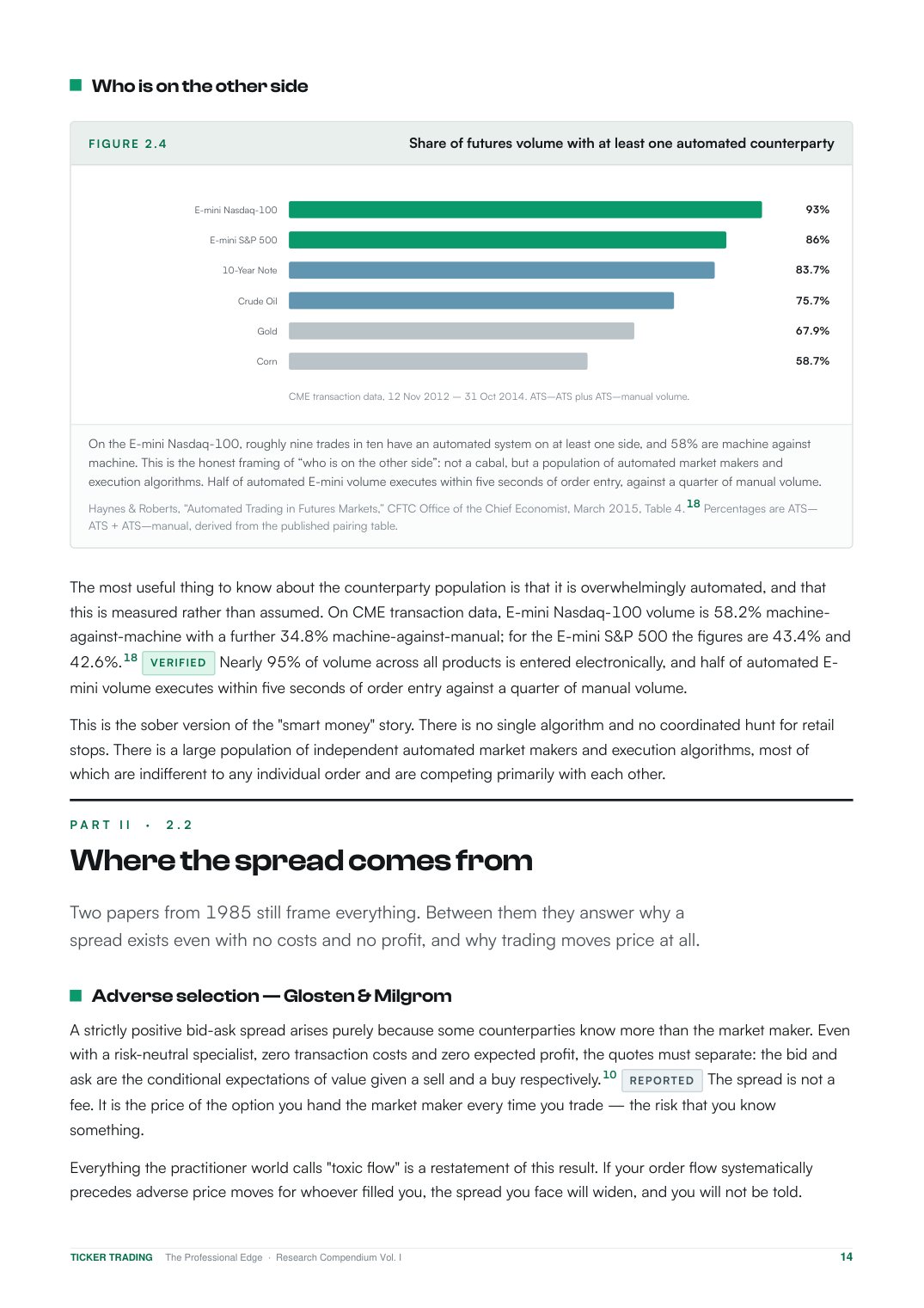
Cover of The Professional Edge, research compendium volume IPage 14: share of futures volume with an automated counterparty, 93% on the E-mini Nasdaq-100
Research compendium · 68 pages · 63 sources

The Professional Edge

Order flow, options flow, macro, and the standard of proof that turns any of them into a strategy you can trade.

  1. The Frame: why the retail stack underperforms, and what the failure-rate evidence really says
  2. Order flow and market microstructure: the order book, price formation, impact, and what the tape cannot tell you
  3. Options flow and dealer positioning: the variance risk premium, dealer gamma, expiration effects, 0DTE
  4. Macroeconomics for traders: regimes, the policy reaction function, event studies
  5. Validation, concept to strategy: multiple testing, overfitting probability, deflated Sharpe, walk-forward
  6. Synthesis: the integrated stack and what it implies for an MNQ trader
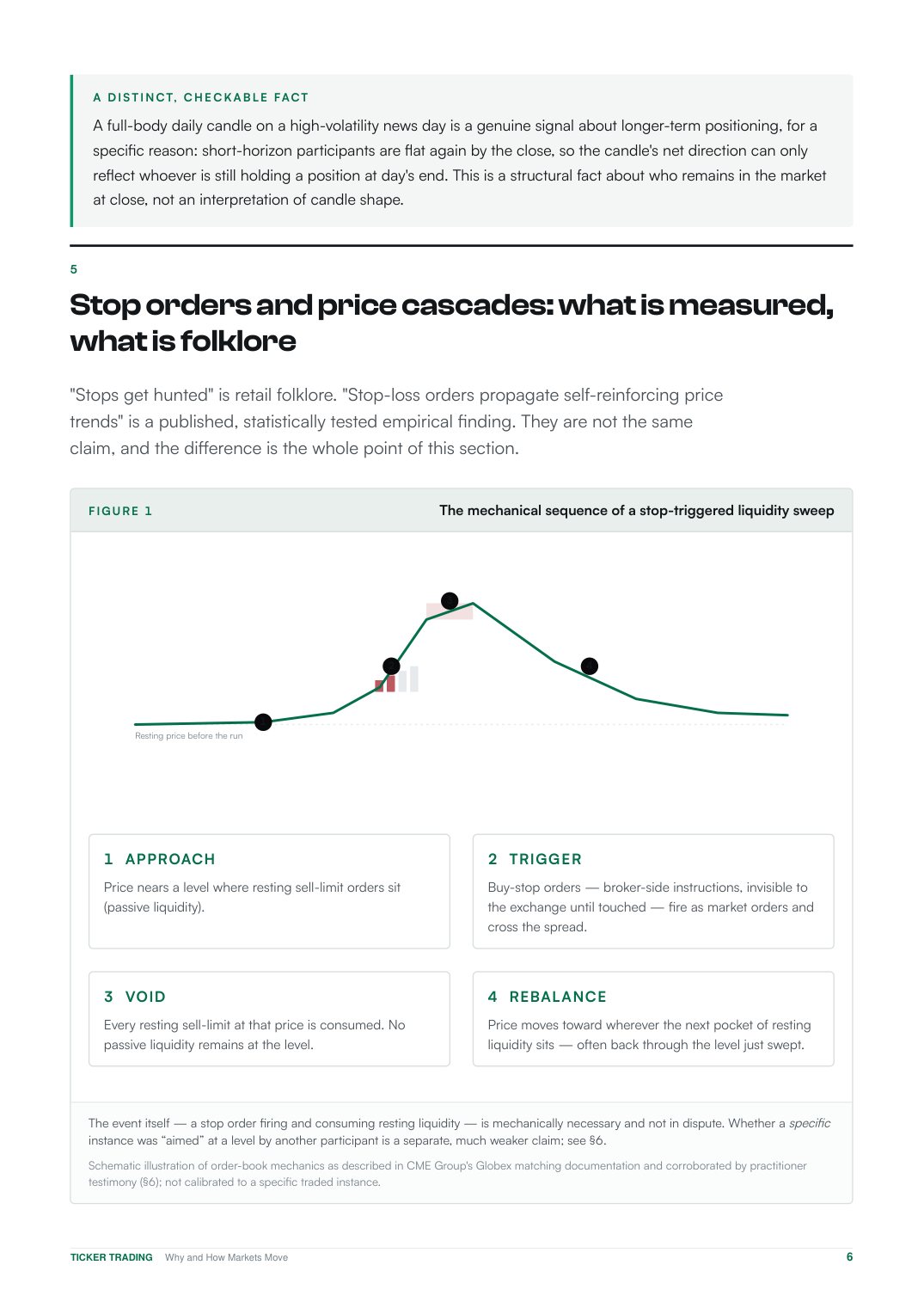
Cover of Why and How Markets Move, research notePage 6: the mechanical sequence of a stop-triggered liquidity sweep
Research note · 15 pages

Why and How Markets Move

Auction theory, order flow and the mechanics of price. It separates what the research and the exchange rulebooks actually show from the stop-hunting folklore.

  1. The market as a continuous auction: Kyle (1985) and Market Profile reach the same answer
  2. How a matching engine actually allocates a fill
  3. Stop orders and price cascades: what is measured and what is folklore
  4. Why the visible order book is not the real order book
  5. Implications for a mechanical, rule-based approach

Start with a free call.

Thirty minutes on your account. If the program isn't right for you yet, I'll tell you.